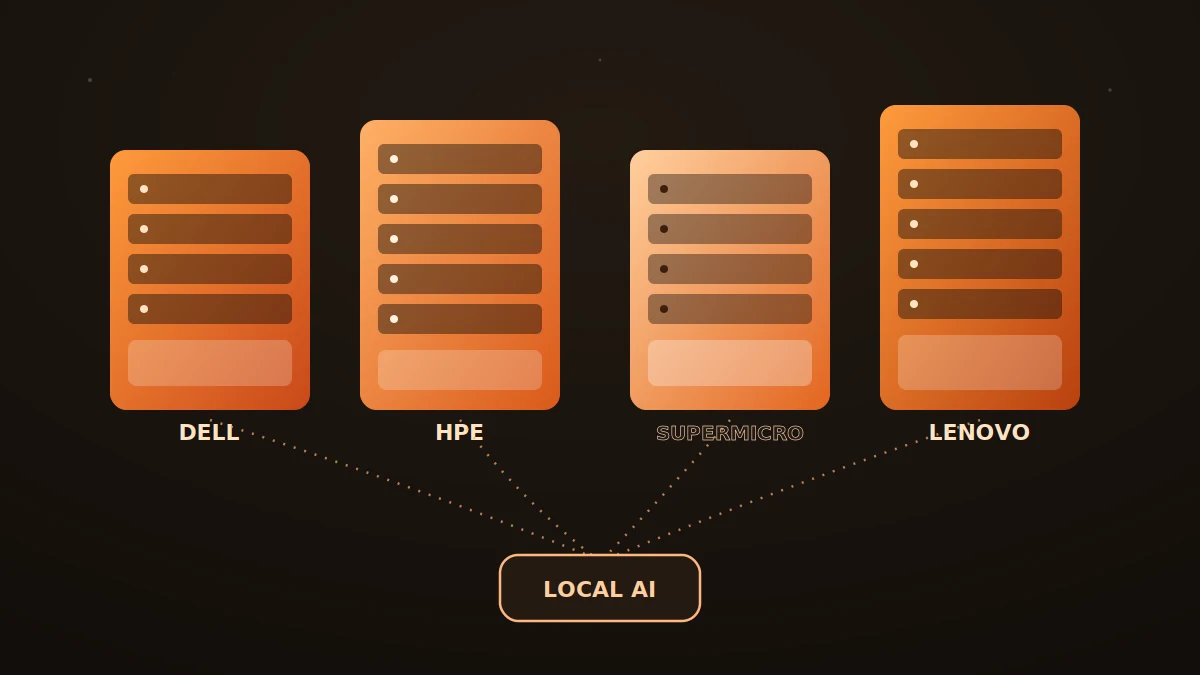
When a business decides to deploy Local AI, "which AI model should we use" is usually asked first — but "which server will it run on" is what actually determines whether the system stays stable, fast enough, and able to scale over the long term. In recent years, every major server maker has released a product line purpose-built for AI workloads — distinct from traditional enterprise servers in how many GPUs they can hold, how effectively they dissipate heat, and how much bandwidth connects the GPUs to each other.
Dell PowerEdge is one of the most widely deployed lines. For moderate needs, the R760xa or R7725 support a handful of GPUs inside a general-purpose server. For stronger configurations — 8 GPUs in one machine with high-speed NVLink communication — Dell offers the well-proven PowerEdge XE9680, now transitioning to the newer XE9880L/XE9885L generation built on the NVIDIA HGX Rubin platform. Dell's strength is its very broad global service and warranty network, which suits businesses that want reliability proven over time.
HPE ProLiant leans heavily into security and pre-integrated solutions. The ProLiant Compute DL380a Gen12 supports up to 8 NVIDIA RTX PRO 6000 Blackwell GPUs in a 4U chassis, while the DL385 Gen11 fits a leaner 2-GPU configuration. What stands out is HPE Private Cloud AI — a full-stack offering that bundles servers, networking, storage, and management software, with an air-gapped deployment option (fully isolated from the internet) — a strong fit for industries with strict security or data-sovereignty requirements.
Supermicro stands out for flexibility and speed to market. Its "Building Block" architecture lets CPUs, GPUs, and cooling systems be mixed and matched, resulting in hundreds of configuration options — from air-cooled 8-GPU H200 systems like the SYS-821GE-TNHR to newer liquid-cooled platforms for Blackwell B200/B300 GPUs that pack far more compute density into the same rack. It's often the choice when a business wants to optimize cost per GPU while still keeping performance high.
Lenovo ThinkSystem strikes a balance between flexibility and peak performance. The SR675 V3 is a versatile 3U server supporting up to 8 GPUs, suited to both training and inference. At the higher end, the SR680a V4 is an 8U server purpose-built for generative AI with 8 NVIDIA B300 GPUs, using Lenovo's own Neptune liquid-cooling technology to achieve high compute density within limited data-center space.
DABO isn't tied to a single vendor. It assesses each business's actual needs — model size, expected number of concurrent users, budget, and the real power and cooling conditions at the installation site — before recommending the right server platform from reputable partners like the ones above. Researching, comparing, and negotiating across multiple server makers is work DABO does on the customer's behalf, so the business can focus purely on putting AI to work.