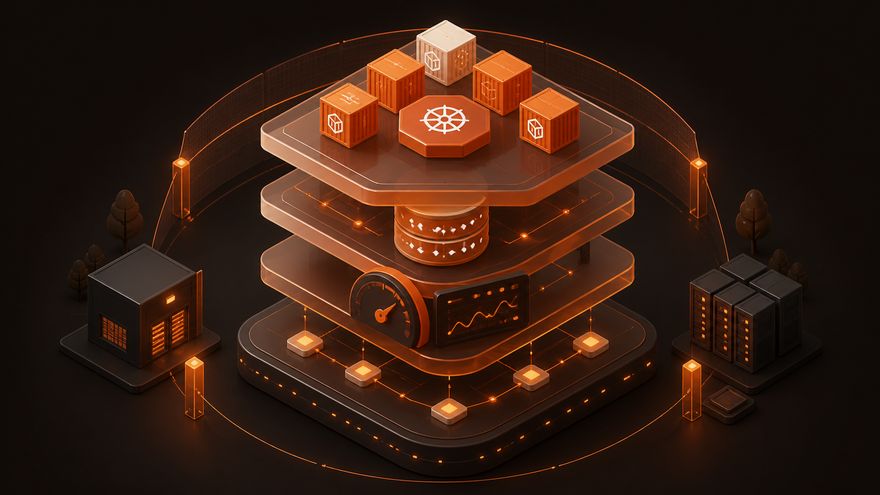
Quick summary: A reliable Local AI system combines several infrastructure layers: container packaging (Docker/Kubernetes), inference serving, the data/knowledge layer (vector database), and governance-security, and can run fully air-gapped for the highest security needs.
Many people picture Local AI as simply "download a model and run it". In reality, a system that runs reliably in an enterprise is the coordination of several infrastructure layers, each with a clear role. Understanding this architecture lets an IT team deploy and operate AI professionally, securely and at scale.
The packaging and deployment layer is usually container-based. Docker packages the model, libraries and configuration into consistent units that run identically everywhere. When you need to orchestrate many containers across many servers — auto-restart on failure, load balancing, scaling on demand — Kubernetes becomes the standard tool for managing the whole lifecycle.
The inference-serving layer turns a model into a callable service, optimised to handle many concurrent requests at low latency. Modern serving engines use batching, context-memory management and GPU optimisation to squeeze the most from expensive hardware.
The data and knowledge layer revolves around the vector database — where embeddings for RAG are stored. This is the component that lets the assistant retrieve the right relevant documents in milliseconds, even when the knowledge base reaches millions of passages. Around it sit the ingestion, update and data-permission processes.
The governance, security and monitoring layer wraps everything: user authentication and authorisation, audit logging, data encryption, performance tracking and incident alerting. This is the layer that turns a system that "works" into one that is "trustworthy enough for production".
For organisations with the highest security requirements, the entire architecture can run air-gapped — fully isolated from the Internet. In this model, models, libraries and updates are brought in through a tightly controlled process, and no data flow can accidentally escape. This is the gold standard for defence, core finance and top-secret data.
The key point: the power of Local AI lies not in a single model but in how these infrastructure layers are designed to work together safely and durably. DABO packages all that complexity into a complete platform, so businesses focus on value rather than stitching each piece together themselves.
Frequently asked questions
What do Docker and Kubernetes do? Docker packages the model and configuration into consistent units; Kubernetes orchestrates many containers across servers, auto-restarting on failure and scaling on demand.
What is the vector database for? It stores embeddings for RAG, letting the assistant retrieve the right documents in milliseconds even with millions of passages.
What is an air-gapped environment? Infrastructure fully isolated from the Internet, the gold standard for defence, core finance and top-secret data.