When a business first starts with Local AI, running on a single GPU server is normal — low cost, easy to set up, plenty for a pilot phase. But once that AI assistant becomes a tool employees rely on every day, one question has to be answered: if that server fails — a disk failure, a power outage, a GPU driver error, or simply scheduled maintenance — what happens? With a single-server architecture, the answer is usually: the entire AI system goes down until the machine is fixed.
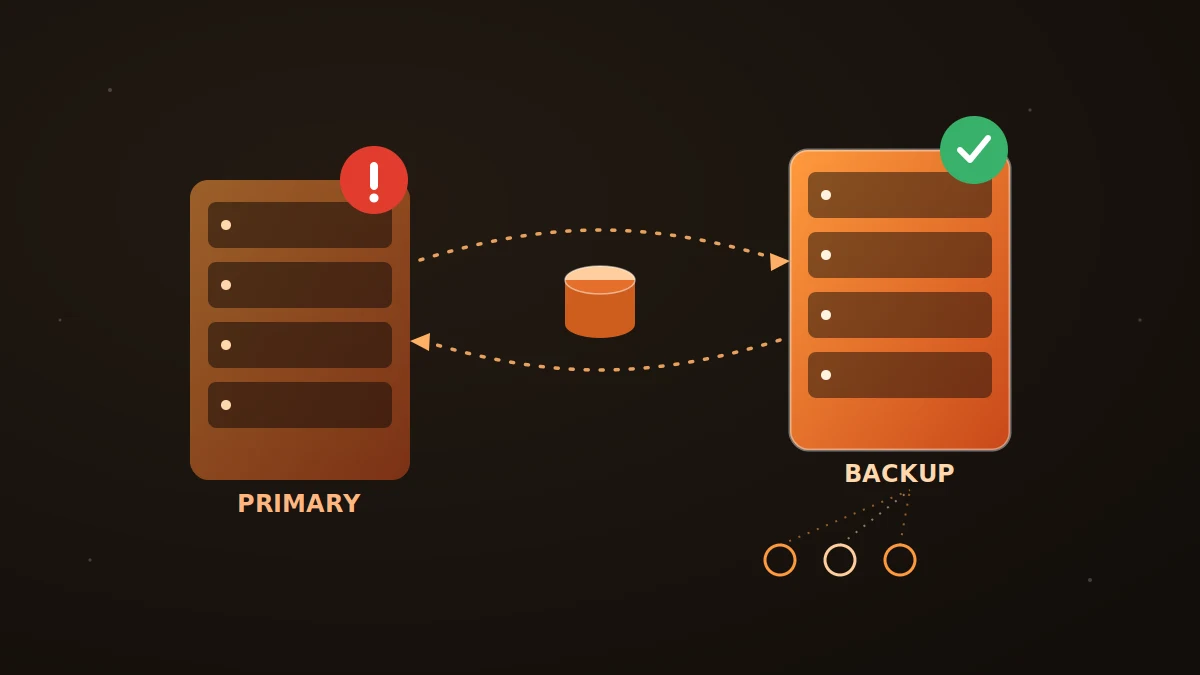
Replication — duplicating data and services — is how that problem gets solved. Instead of one server handling every request, the system runs one or more standby backup servers with the same AI model, the same configuration, and, most importantly, data that's continuously synced with the primary. That sync isn't just a copy of the AI model — it also includes the vector database (where the internal knowledge the AI assistant draws on is stored), conversation history, and related configuration, so the backup server is always ready to serve with the latest data, never "stale" compared to the primary.
Failure detection typically relies on health checks — the primary server continuously sends an "I'm fine" signal (a heartbeat) every few seconds. When the backup stops receiving that signal for a set period, the system understands the primary has failed and automatically triggers failover — rerouting all traffic to the backup. With a "hot standby" setup (the backup already running in parallel, ready to absorb load), this switchover typically takes just a few seconds, and users barely notice anything happened.
There's a less costly alternative: "cold standby," where the backup server doesn't run continuously but only starts up once the primary actually fails. This saves on hardware and power costs, but recovery takes longer — from a few minutes to tens of minutes depending on the setup — since the backup needs time to load the model and sync the latest data before it can serve requests. The choice between hot and cold standby depends on how critical that AI assistant is to the business's day-to-day operations.
DABO builds this replication layer into deployments from mid-scale upward, so customers never have to research or operate it themselves. During the Pilot phase, the system typically runs on a single server to keep costs low; once a business moves to full deployment, DABO advises on and configures the right standby architecture — hot standby for systems that need to run continuously, cold standby for less time-critical workloads — so business data always stays protected and the AI assistant stays available, without needing a separate infrastructure team.