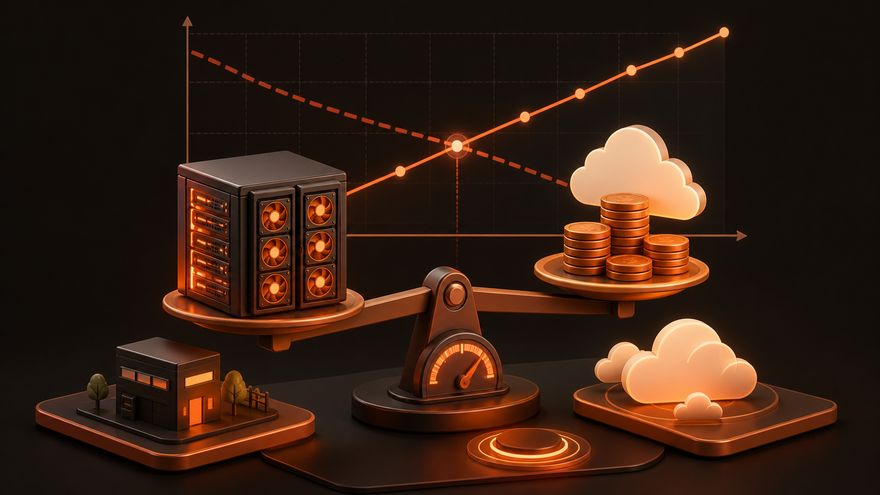
Quick summary: Cloud AI bills by usage so cost rises without limit as you scale, while Local AI is a near-fixed investment where cost per task keeps falling — past a certain break-even point, Local AI is usually cheaper long-term.
The question "is Local AI or Cloud AI cheaper" has no universal answer, because the two models have completely different cost structures. Understanding that structure is the key to a smart investment decision.
Cloud AI follows an operating-expense model: you pay per usage, usually per thousand input and output tokens. The upside is almost no upfront investment, fast start and easy experimentation. The downside shows up as scale grows: cost is proportional to usage, and the more successful you are — more employees using it, more automated tasks — the bigger the bill, with no ceiling.
Local AI follows a capital-expense model: you invest upfront in hardware (mainly GPUs), deployment and configuration, after which operating cost is mostly power, cooling and maintenance. The key point is that cost is nearly fixed regardless of how many tasks you run — meaning cost per answer keeps falling as usage rises.
This gives rise to the break-even concept. At low usage, cloud is usually cheaper. But once volume passes a certain threshold, the total cost of ownership (TCO) of an on-premise solution becomes lower, and the gap widens over time. For organisations rolling out AI broadly, that threshold arrives far sooner than first imagined.
But cost is not just the number on the invoice. Local AI delivers value that is hard to price directly yet very real: eliminating data-leak risk, ensuring compliance, freedom from vendor price swings, and keeping core capability in your own hands.
Practical advice: compute TCO over a 3-year lifecycle, including the hidden costs of cloud (data transfer, compliance risk, vendor dependence) and the value of ownership. For many businesses with steady AI needs and sensitive data, Local AI is not only safer but also cheaper in the long run.
Frequently asked questions
When is Local AI cheaper than Cloud AI? Once usage volume passes the break-even point, Local AI's total cost of ownership (TCO) becomes lower, and the gap widens over time.
Over what timeframe should we calculate cost? Calculate TCO over a 3-year lifecycle, including cloud's hidden costs such as data transfer and compliance risk.
What advantage does Cloud AI have? Almost no upfront investment, fast start, well suited to small-scale experimentation.