One reason businesses choose Local AI over cloud AI is to keep data from ever leaving the company. But "never leaving the company" doesn't automatically mean "safe." If the AI server sits on the same network as every employee's computer, printers, security cameras, and other devices, then any device on that network that gets compromised — through a phishing email, malware, or a personal device brought into the office — can become a stepping stone to the AI's data, even though that data never physically left the building.
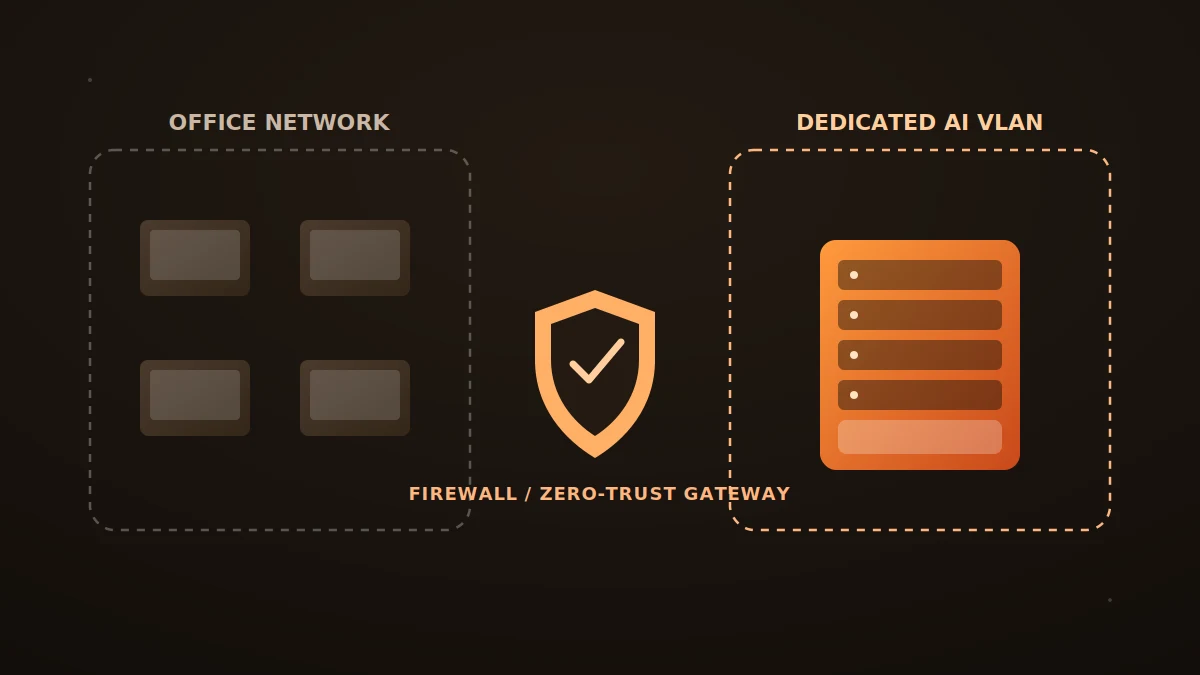
The first layer of protection is network segmentation, typically done with a VLAN — a logically separate subnetwork where the AI server and its related components (the vector database, storage systems) sit apart from the everyday employee network. Physically, both may still share the same cabling infrastructure, but logically they operate as two independent networks — a device on the office network can't automatically "see" or connect to the AI server.
Between the two networks there needs to be a tightly controlled layer — typically a firewall with explicit rules that allow only the specific connections required (for example, the internal chat interface being allowed to send questions to the AI server) and block everything else by default. The zero-trust principle goes a step further: never automatically trust a connection just because it originates "inside" the company network — every request needs to be authenticated, even one coming from a computer sitting right in the office.
For employees who need to reach the AI assistant while working remotely, the connection has to go through a properly authenticated gateway — a corporate VPN or a login gateway with multi-factor authentication — and the AI server should never have an address directly reachable from the public internet. Accidentally exposing an admin panel or internal interface to the internet is one of the most common causes of data exposure in self-hosted AI systems.
DABO designs this network layer in from the installation stage, not as something bolted on after the system is already running. The AI server sits in its own VLAN, firewall rules are configured to match the business's actual data flow, and secure remote-access channels are opened only where needed — so the promise that "data never leaves the business" is backed by a genuinely isolated network layer, not just the fact that the server happens to sit inside the company building.